


@miltonjoyce7809
Profile
Registered: 2 months, 2 weeks ago
The Role of Enclosures in Protecting Machine Vision Components
What happens to a high-resolution industrial camera when it spends a year mounted three meters above a stamping press, bathed in metal dust and coolant mist? What separates a machine vision system that runs uninterrupted for a decade from one that fails within eighteen months? For engineers and integrators tasked with sourcing and deploying machine vision components, these questions are not academic. They determine uptime, warranty exposure, and the total cost of ownership for every camera, lens, and lighting module installed on a production line.
Machine vision cameras and their associated optics, illumination, and processing hardware are precision instruments built to tolerances measured in microns. Yet the environments where these systems deliver the most value - welding cells, food processing lines, foundries, packaging plants - are frequently hostile to exactly that kind of precision electronics. Enclosures exist to resolve this contradiction, acting as the physical interface between delicate imaging hardware and an environment that was never designed with optics in mind. ClearView Imaging UK
This article examines what enclosures actually do, how to evaluate them against real operating conditions, and what technical specifications matter most when you buy machine vision components for a demanding application. It also addresses the recurring question of whether affordable machine vision components can be made industrial-grade through enclosure design alone, or whether enclosure selection has to happen alongside component selection from the start.
(image: https://www.vicoimaging.com/wp-content/uploads/2022/12/blog_system.jpg)
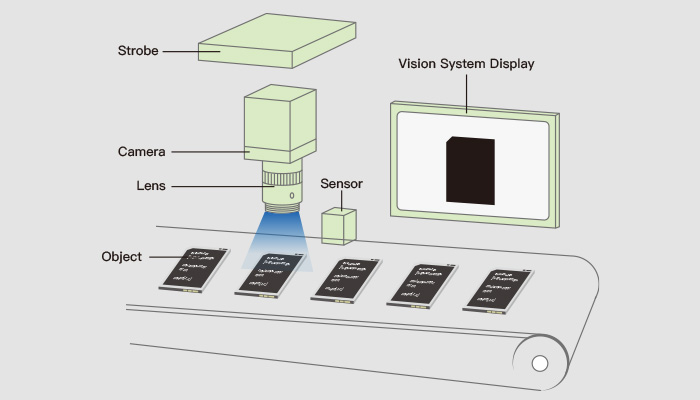
Why Do Machine Vision Systems Fail in Industrial Environments?
Camera sensors and lens assemblies are engineered around tight optical alignment. A shift of a few microns in a lens element, caused by thermal expansion or mechanical shock, can measurably degrade resolution and repeatability in a quality inspection application. Industrial settings introduce three primary stressors: thermal cycling, particulate contamination, and mechanical vibration, each of which acts on the imaging chain differently and each of which an enclosure must be specified to counter.
Thermal cycling causes condensation inside housings when equipment moves between a cold warehouse and a heated production floor, and that moisture finds its way onto sensor windows and connector pins. Particulate contamination, whether metal fines from CNC machining or flour dust in a bakery, settles on lens surfaces and gradually reduces contrast until inspection algorithms start generating false rejects. Vibration from conveyors, presses, and robotic arms loosens connectors and, over time, can shift the relative position of camera and lens well beyond the tolerance a vision algorithm was calibrated against. An enclosure rated correctly for the application interrupts all three failure paths before they reach the optical path.
What IP and NEMA Ratings Actually Tell You About Protection Level
Ingress Protection ratings, expressed as IP followed by two digits, describe resistance to solids and liquids respectively. The first digit, ranging from 0 to 6, indicates protection against dust and foreign objects, while the second, ranging from 0 to 9, indicates protection against water in forms from dripping to high-pressure jets. An enclosure rated IP67 is dust-tight and can withstand temporary immersion, which suits most factory floor applications, while IP69K adds resistance to high-temperature, high-pressure washdown common in food and beverage processing.
(image: https://clearview-imaging.com/cdn/shop/files/Clearview_-19_360x360_crop_center.jpg?v=1732818457)

NEMA ratings, used predominantly in North America, overlap conceptually with IP codes but add criteria specific to corrosion resistance and, in some enclosure classes, protection against ice formation. A NEMA 4X enclosure, for instance, resists corrosion in addition to meeting requirements comparable to IP66, which matters directly for camera housings installed near chemical tanks or outdoor gantries. Buyers evaluating machine vision components should treat these ratings as a starting filter rather than a final answer, because a correctly rated enclosure paired with a poorly sealed cable gland or an incompatible connector can still fail in the field despite the housing itself meeting spec. ClearView Imaging UK
An enclosure is only as protective as its weakest penetration point - the cable gland, the window seal, or the connector interface almost always fails before the housing material does. How Do Enclosure Materials Affect Thermal Management?
Aluminum enclosures dominate industrial machine vision because the metal conducts heat efficiently away from the camera's image sensor and processing board toward external fins or a mounting surface. A GigE or USB3 camera operating continuously can generate several watts of heat internally, and without a path for that heat to escape, sensor temperature rises enough to increase electronic noise in the image, particularly in longer exposure or low-light applications. Passive heat sinking built into the enclosure body, sometimes supplemented with internal thermal pads connecting the sensor board to the housing wall, keeps operating temperature within the range the camera manufacturer specifies for rated performance.
Stainless steel enclosures trade some thermal conductivity for corrosion resistance and structural durability, making them the standard choice in washdown environments where aluminum would pit or oxidize under repeated exposure to caustic cleaning agents. Polycarbonate and composite housings appear in lower-stress applications where weight reduction matters more than thermal performance, such as robotic end-effector-mounted cameras where every gram affects arm dynamics and cycle time. The material decision, in practice, follows directly from the dominant environmental stressor rather than from cost alone.
What Role Do Viewing Windows and Optical Glass Play?
The enclosure's front window sits directly in the optical path, which means any flaw introduces measurable image degradation regardless of how good the camera and lens are. Standard soda-lime glass is inexpensive but introduces slight distortion and reduced transmittance in the near-infrared range, which matters for vision systems relying on NIR illumination for contrast enhancement. Optical-grade borosilicate or sapphire windows, by contrast, maintain flatness and transmittance across a broader spectral range and resist scratching from abrasive dust far better, which extends useful service life in harsh particulate environments.
" (video: https://www.youtube.com/embed/EB-iqzd-pPk)
Anti-reflective coatings on both surfaces of the window reduce stray light and ghosting, an effect that becomes visible as faint duplicate edges in high-contrast scenes if left uncorrected. Heated windows, which use a thin conductive coating or embedded wire element, prevent condensation and frost buildup in cold storage or outdoor applications, a feature that adds cost but eliminates a common cause of intermittent image quality complaints that are otherwise difficult to diagnose remotely.
How Does Vibration Isolation Preserve Calibration Accuracy?
Machine vision systems used for robotic guidance or dimensional measurement rely on a fixed, known relationship between camera position and the inspection field. Vibration transmitted through a poorly isolated mount gradually works connectors loose and, in extreme cases, shifts the entire camera-lens assembly relative to its calibrated reference frame. Enclosures designed for high-vibration environments incorporate elastomeric mounts or damping inserts between the camera body and the housing, absorbing frequencies in the range typically produced by conveyor motors and pneumatic actuators before they reach the sensor mount. ClearView Imaging Ltd
Rigid mounting without isolation is occasionally preferred in metrology applications where any compliance in the mount introduces its own positional error, so the correct approach depends on whether the dominant risk is high-frequency vibration or low-frequency mechanical creep. Integrators sourcing components for a new line should request vibration test data, typically expressed in g-force across a frequency sweep, from the enclosure manufacturer rather than assuming that any sealed metal housing provides adequate isolation by default.
(image: https://clearview-imaging.com/cdn/shop/files/twenty-twenty-hero_360x360_crop_center.jpg?v=1733136216)

Enclosed vs. Bare Camera Deployment: What Are the Trade-Offs?
Deploying a bare, unenclosed camera is sometimes justified in cleanroom or laboratory settings where the ambient environment is already controlled and the added bulk of a housing would interfere with tight spatial constraints around robotic tooling. In that scenario, the camera's own IP-rated housing, if the model includes one, may be sufficient, and the added protection of a secondary enclosure delivers little practical benefit while increasing mounting complexity and reducing accessibility for lens adjustment. The calculation changes entirely once dust, coolant, temperature swings, or washdown cycles enter the picture, at which point an unenclosed camera becomes a recurring maintenance liability rather than a one-time capital saving.
The table below compares typical outcomes across common deployment scenarios, based on general engineering experience with industrial camera housings rather than any single measured dataset.
Deployment ScenarioTypical Enclosure TypeExpected Service LifePrimary Failure RiskRelative Maintenance Cost Cleanroom electronics inspectionNone or camera-native IP housing5-8 yearsConnector fatigueLow Automotive weld cellAluminum, IP67, active air purge4-6 yearsSpatter accumulation on windowModerate Food/beverage washdown lineStainless steel, IP69K6-10 yearsSeal degradation from chemicalsModerate to high Outdoor logistics gantryAluminum with heater and sunshade7-10 yearsCondensation and UV window agingModerate Robotic arm end-of-arm toolingComposite/polycarbonate, lightweight3-5 yearsVibration-induced connector wearLow to moderate
The pattern across every row is consistent: enclosure choice shifts the dominant failure mode rather than eliminating failure entirely, so specifying the enclosure correctly means identifying which failure mode is acceptable for the application's maintenance schedule and budget. A plant running three shifts with minimal scheduled downtime should weight service life and seal durability far more heavily than upfront enclosure cost, since an unplanned camera replacement on a live production line typically costs far more in lost throughput than the price difference between a standard and a premium housing.
" (video: https://www.google.com/maps/embed?pb=!1m18!1m12!1m3!1d2470.463322252579!2d-1.0071635999999997!3d51.7428508!2m3!1f0!2f0!3f0!3m2!1i1024!2i768!4f13.1!3m3!1m2!1s0x4876f4893f46b4fb20Imaging!5e0!3m2!1sen!2suk!4v1783677888812!5m2!1sen!2suk) " (video: https://en.wikipedia.org/wiki/Machine_vision)
Does Enclosure Quality Justify a Higher Price for Machine Vision Components? Frequently Asked Questions
Do I need a special enclosure if my camera already has an IP67 rating from the manufacturer?
Not necessarily, if the operating environment matches what IP67 covers - dust and temporary immersion. However, additional protection is still worth adding for vibration damping, sunshading, or chemical resistance if the environment exceeds those specific conditions.
How often should enclosure seals and windows be inspected on a running line?
A quarterly visual check is typical for standard industrial environments, while washdown or high-particulate lines usually warrant monthly inspection of gaskets, gland fittings, and window clarity. Seal degradation is often gradual and easy to miss until image quality already suffers.
Can an enclosure reduce the resolution or field of view of a machine vision camera?
A poorly chosen window or an enclosure that places glass too close to the lens can introduce vignetting or minor distortion. Selecting an enclosure rated for the specific lens's field of view and working distance avoids this entirely.
Is it worth retrofitting enclosures onto an existing machine vision system instead of replacing the cameras?
In most cases, yes - retrofitting a correctly rated enclosure is far cheaper than replacing cameras damaged by environmental exposure, provided the existing camera and lens still meet the application's performance requirements.
What is the typical cost difference between a standard and a washdown-rated enclosure?
Washdown-rated stainless enclosures generally cost noticeably more than standard aluminum housings due to material and sealing requirements, but the difference is usually recovered quickly through reduced downtime and extended service life in food and beverage or pharmaceutical settings.
Website: https://logixy.net/user/ClarissaHarkness/
Forums
Topics Started: 0
Replies Created: 0
Forum Role: Participant